GROUND LIST

Wednesday, 6 April 2022

BRERA CALCIO (Arena Civica Gianni Brera)

FENIX TROPHY GROUP STAGE, BRERA CALCIO 1-3 FC UNITED of MANCHESTER, ATTENDANCE: c500

Let the Fenix fly!

Our final match of our short break, and what was the starting point for this whole trip being undertaken, was the Fenix Trophy Group game between Brera Calcio.

The Milan club were the brains behind the competition, established to promote the "experience of cultural exchange" between 8 non-professional clubs chosen for their "exceptional social, historical and cultural distinctiveness". My mate who was us jokingly (I think) remarked "What about Chester FC then?"

Anyway, the 8 clubs contesting the trophy are from 7 countries and split into two groups of four. Group A consists of HFC Falke (from Hamburg in Germany) 
AS Lodigiani Calcio 1972 (Rome, Italy) Cuenca-Mestallistes 1925 (Valencia, Spain) and Prague Raptors FC (Prague, Czech Republic).

Group B consists of Brera (from Milan in Italy) FC United of Manchester (Manchester, UK) AFC DWS (Amsterdam, Netherlands) and AKS Zly (Warsaw, Poland).

Tonight's game concerned group B leaders FC United against Brera Calcio. A win would ensure the Mancunians would top the group and play in the final in Rimini in June.

Brera Football Club was founded in 2000, with the club's first ever coach being Italian goalkeeping legend Walter Zenga. After relegation from Serie D the club have spent the last couple of decades flitting between the tiers of non-league football. They are currently at level 7 in Italian football. It is where they play their home games though that is the most interesting aspect.

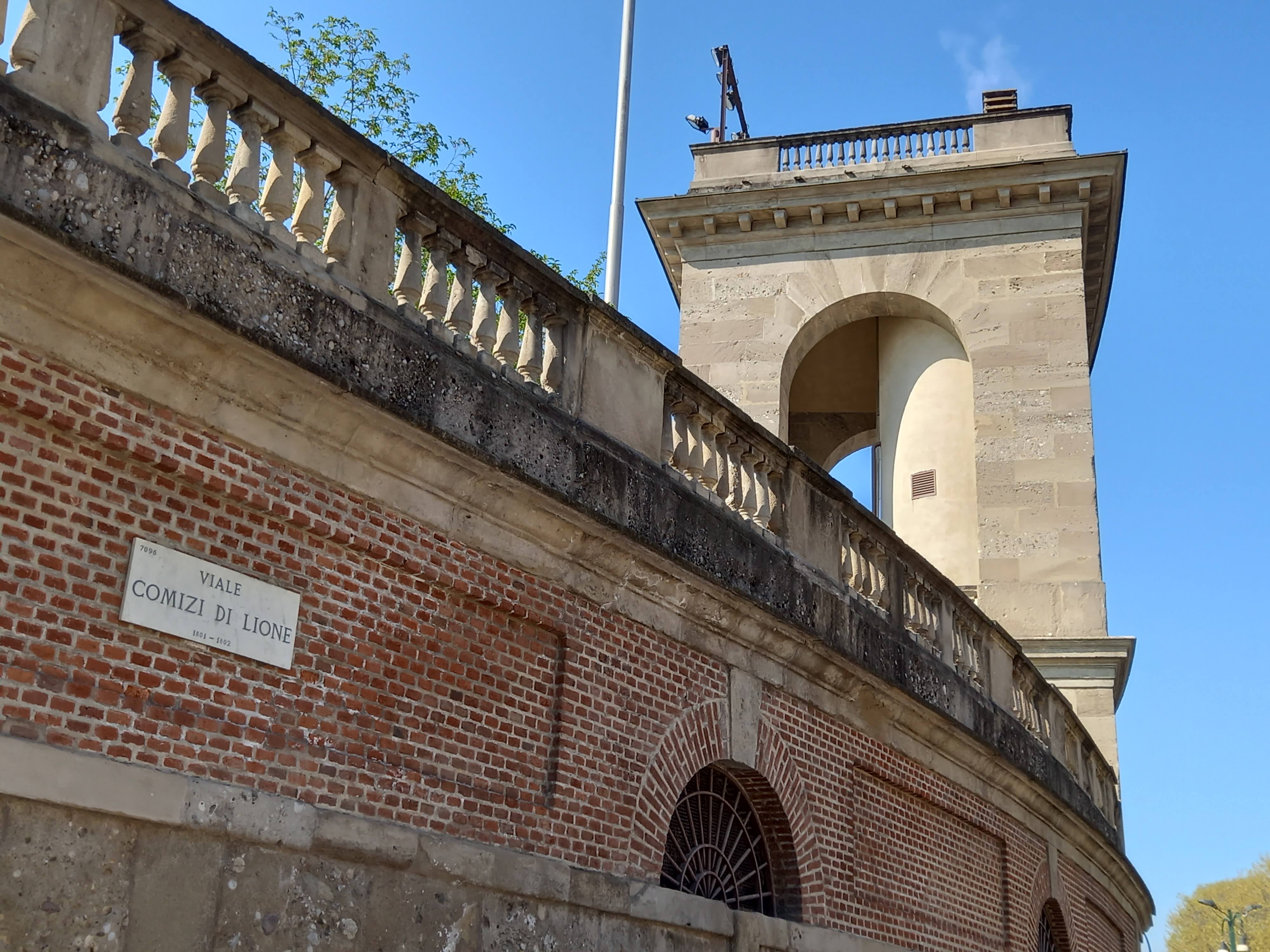
There are not many grounds you can go to where you actually get a historic feel for the place, but the Arena Civica is definitely one of those places. How many grounds still in use have a direct connection to Napoleon? 

In the shadow of Castello Sforzesco, the Arena Civica was built at the request of the aforementioned Napoleon Bonaparte, who declared the city needed a venue to celebrate and showcase its wealth. Originally named Arena del Foro Bonaparte, it was inaugurated in 1807. 

Built by Luigi Canonica, it was used for chariot racing and it's design also allowed it to be flooded with water from nearby canals in order to stage mock sea battles. It became the Arena Civica in 1870 after passing to the Milanese municipality.


Both Milan clubs used the Arena Civica for homes games in their early years, but Inter played here permanently between 1930 and 1947, where they won the Scudetti in 1937/38 and 1939/40. Afterwards both clubs eventually made the San Siro their home, which was built by AC in 1935, after ownership of that stadium also passed to the municipality. 

The combination of war damage and growing attendances forcing the hand of I Nerazzurri into moving to the San Siro. The San Siro is officially named after Giuseppe Meazza, who played for both clubs but is considered an Inter legend as player and coach. He scored 240 goals for Inter, most coming at the Civica. 

Inter continued to play sporadically at the Civica after 1947 and played their last game at the Arena in 1958, beating Lyon 7-0 in the Inter Cities Fairs Cup. In 2002 the Arena was dedicated to the memory of Gianni Brera, journalist, and writer, who died ten years earlier. Brera Calcio have played here since their formation.


Despite the history of the stadium, I have to confess that the view for spectators of the match was quite poor and I, like the other fans in attendance, was well away from the action. Though, as it turned out, there was not a lot of action to see. A largely forgettable match, the second half being especially drab, was won by United to put them within one point of the Fenix Trophy final.

The game was a tale of three penalties. Paola Catalidi (18) gave the homesters the lead from the spot, after a handball, before running the length of the pitch to give it the big one in front of the United fans. They weren't in the lead for long as Charlie Ennis (21) equalised for United, also from penalty spot, after a trip in the box.

United went into the break leading thanks to a strike from Ali Waddecar (34) and wrapped the game up in the in 89th minute with another penalty, tucked home by Regan Linney.

That concluded our brief Italian tour, it was great to be on a football trip once again. Just a shame it couldn't be for a little bit longer. Hopefully next time...


Thanks to Markus, James, Barney and Jim for use of the photographs.

PARMA CALCIO 1903 (Stadio Ennio Tardini)

SERIE B, PARMA CALCIO 4-3 COMO 1907, ATTENDANCE: 5,310

Our first game of the day took us to the city of 'ham and cheese' for an afternoon encounter at the Stadio Ennio Tardini. 

Parma is, of course, the world famous home of Parmaesan cheese and Parma ham. Indeed these are protected designations of origin for foods and, under Italian and European law, can only be called so if produced in the provinces of Reggio Emilia . Therefore is was only right and proper that prior to the game we headed to the famous 'La Prosciutteria'  shop in the city to sample the delights!

  "Say cheese"  

There was also time for a few local ales at 'Casa Ducato' before making the 20 walk to the stadium. Parma have certainly have an interesting history to say the least, especially in the recent years.

Originally founded in 1913, the club was declared bankrupt in 2015 and liquidated. The club reformed in Serie D and achieved three successive promotions to return to Serie A before dropping back to Serie B last season.

The financial problems originally went back to the turn of the millennium. After a decade of unprecedented success in which Parma won eight major trophies between 1992 and 2002 - four Coppa Italia, one Supercoppa Italiana, two UEFA cups and one European Cup Winners Cup.

These teams featured legendary players such as Tomas Brolin, Gianfranco Zola, Faustino Asprilla, Dino Baggio, Hernan Crespo and Gianluigi Buffon,  who is still going strong at the age 44 and recently signed a new 1 year contract extension at Parma.

The success in the 1990's was funded by Calisto Tanzi, who was the founder of Parmalat, a multi-national dairy and food company, but he was found guilty of one of largest frauds in European history, leading to the company's collapse. This led to the club going into administration in 2004 before it's eventual demise in 2015.


The Stadio Ennio Tardini has been home to Parma since it's inauguration in 1923, and is named after the former club president. It was he who drew up the plans for the stadium but died before completion. The ground was reconstructed in the 1990's, when the club was promoted to Serie A, to incorporate the requisite number of seats required for top flight football.

Parma were hosting Como this afternoon and with both teams having nothing to play for expectations of a classic encounter were low. However, with no pressure comes freedom and both teams served up a brilliant game to watch. There were chances galore for either side but in the Parma ran out winners by the odd goal in seven.

The teams entered the field to the strains of the Triumphal March from Aida, by the Parma born Giuseppe Verdi, indeed when Parma formed they were originally named Verdi FC in honour of the famous composer.

Franco Vázquez (31) gave Parma a half time lead before substitute Ettore Gliozzi equalised on the hour mark. Gliozzi's second of the match (67) gave Como the lead before two stunning free kicks from Adrián Bernabé (77 & 81) put the home side 3-2 up. A fourth goal from Gennaro Tutino (85) effectively sealed the victory but a late penalty from Gliozzi, to complete his hat-trick, did set up a grandstand finish but Parma held out.

Tuesday, 5 April 2022

UNIONE SPORTIVA CREMONESE (Giovanni Zini Stadium)

SERIE B, UNIONE SPORTIVA CREMONESE 2-1 UNIONE SPORTIVA ALESSANDRIA, ATTENDANCE: 6,311

As travel restrictions to Italy were slightly relaxed in March, the seeds for this trip were planted by an FC United of Manchester supporting mate, who suggested to me a trip to Milan to watch their game at the Arena Civica. It was then pointed out to me that there was a full midweek programme in Serie B so, depending how the finalised schedule panned out, that opened up the possibility of a few more games. Suddenly a trip to the Bel Paese became a no-brainer.

When the fixture schedule was confirmed it allowed the opportunity to take in three games and the first of these was South East of our base in Milan, in the city of Cremona.

Cremona is famous as the home of traditional violin making and was the birthplace of Antonio Stradivari, the most legendary instrument maker of them all. Unfortunately the Violin Museum was closed so, after a visit to the Cathedral, followed by some pre-match beers, we headed up to the ground. It was here we had a slight problem.

My mate had left his passport at the hotel so, because of a lack of identification, they refused to sell him a ticket for the match so he had to head back to the bar to drown his sorrows. Luckily a local family having a dinner took pity on him so at least he had some free food a drink to console himself with!


Unione Sportiva Cremonese were founded in 1903 and were inaugural members of Serie A in 1929 but, save for a few seasons here and there, they have spent most of their history below the top flight. Their most recent spell in Serie A was between 1993 and 1996 during which time they also lifted the Anglo-Italian at Wembley, beating Derby County 3-1 to lift the trophy 1993.

Cremonese have played at the Stadio Giovanni Zini since it was opened in 1929, the ground being named after the Cremonese goalkeeper who died during World War I. The ground has been redeveloped in recent years, leaving the capacity at just over 20,000, with the only terracing remaining being behind both the goals. Naturally the home ultras gravitate to the Nord Curva.


This season the I Grigiorossi could be set to return to the top flight of Italian football. As of this evening, there are six games left to play and Cremonese sit top of Serie B. It is very tight at the top of table with just five points separating the top five. The equation was straightforward though - keep winning and there is nothing any other team can do.

The visitors tonight, U.S. Alessandria needed a win for entirely different reasons as they are just a couple of points above the relegation zone.

Luca Strizzolo (28) rolled the ball into the net to give Cremonese the lead, this was at the second attempt after his initial effort was saved. Cedric Gondo received two yellow cards in 14 minutes to reduce the homesters to 10 men just before half time.

However, within a couple of minutes of the restart, Gianluca Gaetano (47) made it 2-0, slotting home after a mazey run through the Alessandria defence. The visitors quickly responded and Simone Palombi (49) fired home an effort which squirmed through Marco Carnesecchi into the goal, definitely a howler by the goalkeeper.

Despite some late pressure, Alessandria never really looked like grabbing an equaliser and the homesters held on to remain top of the table.

The last train back to Milan was at 2130 and the station was an easy 20 minute walk from the ground, so the train was comfortably made meaning there was was time for a few beers before bedtime.